




Extreme Humour in The Pitch Black Anthology
Anthology
Black comedy doesn’t look much today like it did in the ’70s or ’90s. Some films are now hard to imagine in a cinematic landscape where audiences and industry alike are far more attentive to the limits of humour and what can become the subject of a joke.
That’s precisely why the The Pitch Black Anthology selection at the 25th edition of the Transilvania International Film Festival (June 12–21, 2026, Cluj-Napoca) also functions as a small history of how our relationship with laughter, discomfort, and the idea of “too much” has shifted.
From surrealist satires and stories of cannibalism and kidnappings to recent films that shift the absurd toward the anxieties of the present, the section brings together established auteurs such as Luis Buñuel, Pedro Almodóvar, Quentin Dupieux, or the Coen Brothers with the enfants terribles of the moment. Some of these films still shock; others feel surprisingly contemporary — but all share the same pleasure of turning the most uncomfortable situations imaginable into reasons to laugh.
Anker walks out of prison after 15 years, determined to recover the money he hid before his conviction — but the plan quickly unravels: his brother, the only one who knew where it was buried, now has multiple personality disorder and sometimes believes he is John Lennon. Between bizarre therapies, lost memories and treks through the woods, the two try to retrace the path to the cash. All of this unfolds in The Last Viking (dir. Anders Thomas Jensen, 2025).
What begins as a couple's attempt to help a teenager with violent outbursts gradually turns into an increasingly unsettling psychological game, in which the line between help and control disappears entirely. Good Boy (2025), the new film by Jan Komasa, the director behind Corpus Christi and Suicide Room, premiered at the Toronto International Film Festival and follows the same combination of psychological tension and characters pushed to their limits.
Shot entirely on an iPhone, Mortician (dir. Abdolreza Kahani, 2025) introduces us to an Iranian man living in Canada who prepares bodies for burial according to Islamic rites. When the company he works for shuts down and he faces the prospect of returning home, he comes into contact with a famous Iranian singer who plans to livestream her own suicide on social media as a protest against the Tehran regime. Their encounter, however, changes both their plans.
Also exploring the world of funeral services is the documentary 2m² (dir. Volkan Üce, 2026), which follows a Belgian funeral entrepreneur who works with the local Turkish community. Between international repatriations, paperwork and conversations with grieving families, he must find an answer to a difficult question: where does someone who has split their life between two countries find their final resting place?


With a title that needs little explanation, Fuck My Son! (dir. Todd Rohal, 2025) kicks off from a completely unhinged premise: a controlling mother kidnaps a woman in the hope that she will have sex with her son, who was disfigured in an accident. A blend of grotesque horror, filthy humour and situations constantly pushed to the extreme, the film bears the unmistakable influence of John Waters and will leave audiences either howling with laughter or walking out in outrage. The former is recommended.
Anyone who has seen even one film by Quentin Dupieux already knows to expect something completely unpredictable, and The Piano Accident (2025) is no exception. The film follows an influencer (Adèle Exarchopoulos) known for her shocking videos who, after a serious accident during a shoot, retreats to an isolated mountain cabin with her assistant. The peace is quickly shattered when a journalist begins to blackmail her, and the situation gradually slides into delirium, paranoia and chaos.
An essential film of the early ‘90s — and for the subsequent career of Jean-Pierre Jeunet, Delicatessen (co-directed with Marc Caro in 1991), imagines a post-apocalyptic France in which food has become the most valuable currency. In an isolated apartment building run by a butcher with decidedly dubious methods, the arrival of a former circus performer begins to disturb the fragile balance among the tenants.
One of the defining films of Luis Buñuel, The Discreet Charm of the Bourgeoisie (1972) transforms the elegant gestures and rituals of the bourgeoisie into a succession of increasingly absurd, uncontrollable situations. Starting from a seemingly banal premise — a group of bourgeois acquaintances who repeatedly fail to sit down for dinner together — the film drifts constantly between dream, farce and social commentary, skewering rigid politeness, middle-class comfort and the absurdity of social convention.


Four friends retreat to a villa with a single, clear purpose: to eat themselves to death. The premise of La Grande Bouffe (dir. Marco Ferreri, 1973) is more tragic than comic and functions as a critique of consumer society — though that doesn’t make it any less funny. The film, starring among others Michel Piccoli and Marcello Mastroianni, caused an enormous scandal at its Cannes premiere but has since achieved cult status.
Pepi, Luci, Bom and Other Girls Like Mom (1980) marks the debut of Pedro Almodóvar and already contains many of the obsessions and directions that would come to define his filmography: unconventional relationships, queer characters, uninhibited sexuality, and the blend of melodrama, camp and absurdist humour. As a full-circle moment, TIFF.25 will also screen the director's most recent film, Bitter Christmas.
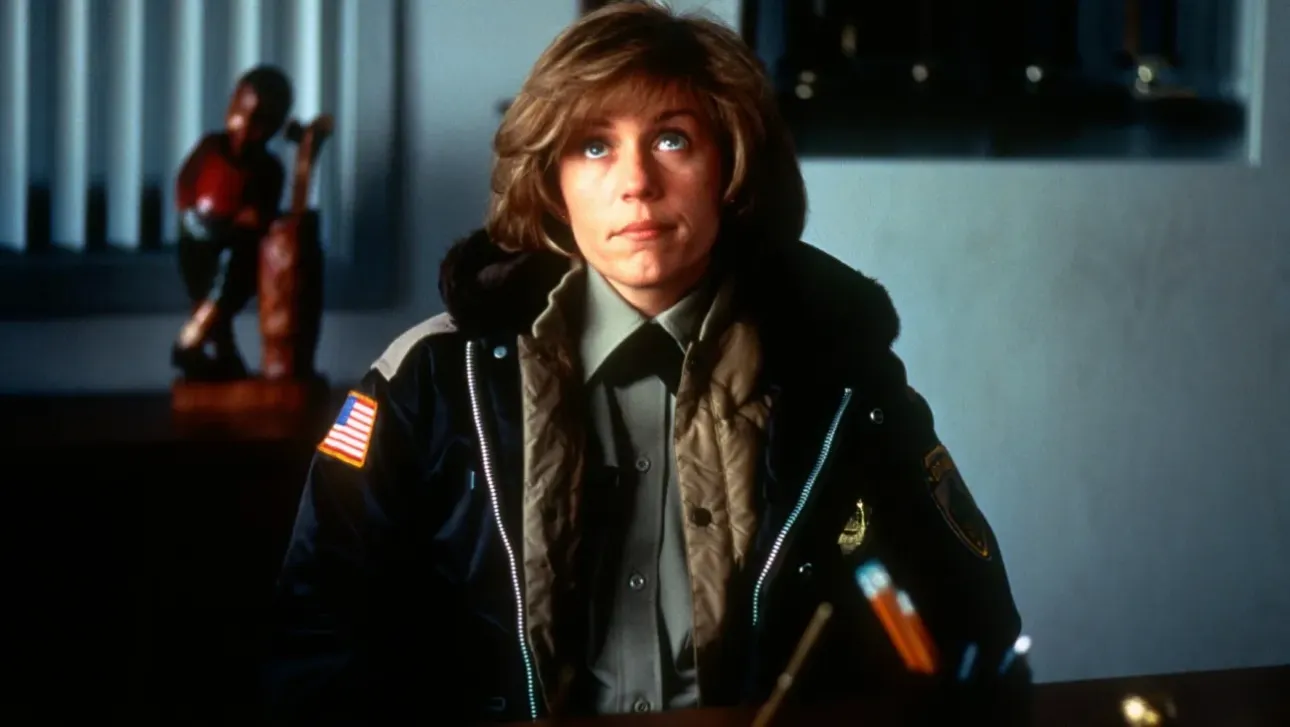
In Fargo (1996), Joel and Ethan Coen take a story about money, kidnappings and desperate people and turn it into a film where tension and comedy coexist almost continuously. A poorly conceived plan sets off a chain of violent and ridiculous situations, tracked by one of the most memorable police officers in the cinema of the ’90s, played by Frances McDormand, who won a well-deserved Oscar for the role.
The Bruges of In Bruges (2008) looks like a postcard, but Martin McDonagh uses it as the backdrop for a story about two hitmen stuck between orders, regrets and far too much free time. From the combination of Colin Farrell's nervous energy, Brendan Gleeson's calm and Ralph Fiennes's unpredictable force comes one of the most distinctive crime-comedy films of the 2000s.


The Cable Guy (1996) looks at first like a typical Jim Carrey comedy, but Ben Stiller (here in the director's chair) quickly steers everything into far darker territory. What begins as a mundane interaction with a cable technician gradually transforms into a blend of stalking, emotional dependency and commentary on TV culture and urban isolation.
The world of Happiness (dir. Todd Solondz, 1998) is populated by people who constantly say the wrong things, hide their darkest impulses and try to maintain the appearance of a normal life. Some of them can be downright repugnant, but the director never condescends to them — he even tries to present their version of the truth. A comedy as dark and uncomfortable as they come, and not to be missed.
Before Trainspotting became the film of a generation, Danny Boyle made his debut in 1994 with Shallow Grave, a blunt-force comedy (in every sense) that launched Ewan McGregor's career, about a group of Edinburgh flatmates who find themselves in a rather unusual situation: their new housemate dies unexpectedly and leaves behind a suitcase full of cash.


Further details about the TIFF.25 programme will be announced shortly. Festival passes are now on sale online: https://tiff.ro/abonamente
***
Follow us on:
tiff.ro | Facebook | Instagram | Youtube | TikTok
***
The Transilvania International Film Festival is organised by the Association for the Promotion of Romanian Film and the Transilvania Film Festival Association.
With the support of: Ministry of Culture, National Centre for Cinematography, Cluj-Napoca City Hall and Local Council, Romanian Cultural Institute, Dacin Sara, UCIN, Department for Interethnic Relations – DRI, Floreşti Commune City Hall, Creative Europe – MEDIA
Under the aegis of: UNESCO City of Film
Presented by: Banca Transilvania
Sponsors: Mastercard, Vodafone, LIDL România, Ursus, Regina Maria, Audi & Autoworld, MOL România, Pepsi, DeLonghi, Adrem, Jidvei, Nikon, Alstom, Emerson, McDonald’s, Farmec, Radisson Blu, Iulius Mall, Conceptual Lab by Theo Nissim, Teilor, Linde, CSI, ECCO, Nova Power
Official Coffee: Nespresso
Official Beauty Partner: Armani Beauty
Official Insurer: Groupama
Technology Partner: Reea
Hospitality Partner: Eximtur
Partners: Bolt, PMA, Promelek, Intend, Lecom, Luna Cleaning, Cărtureşti, Mobexpert, Supecom, Goto Parking
Lead Media Partner: PRO TV & VOYO
Recommended by: ROCK FM
Monitoring Partner: MediaTRUST
Media Partners: Radio România Cultural, TV5, Adevărul de Weekend, A LIST, Agerpres, Hotnews, Liternet, Observator Cultural, Revista FILM, Zile şi Nopți
International Media Partners: Variety, Screen International